Facing a situation that seemed unalterable in the 1970s, Havel maintained that truthful words and actions of citizens matter, and that each of us has the responsibility to be a bit more courageous than we want to be.
Timothy Snyder, Introduction to Václav Havel’s ‘The Power of the Powerless’ (1978)
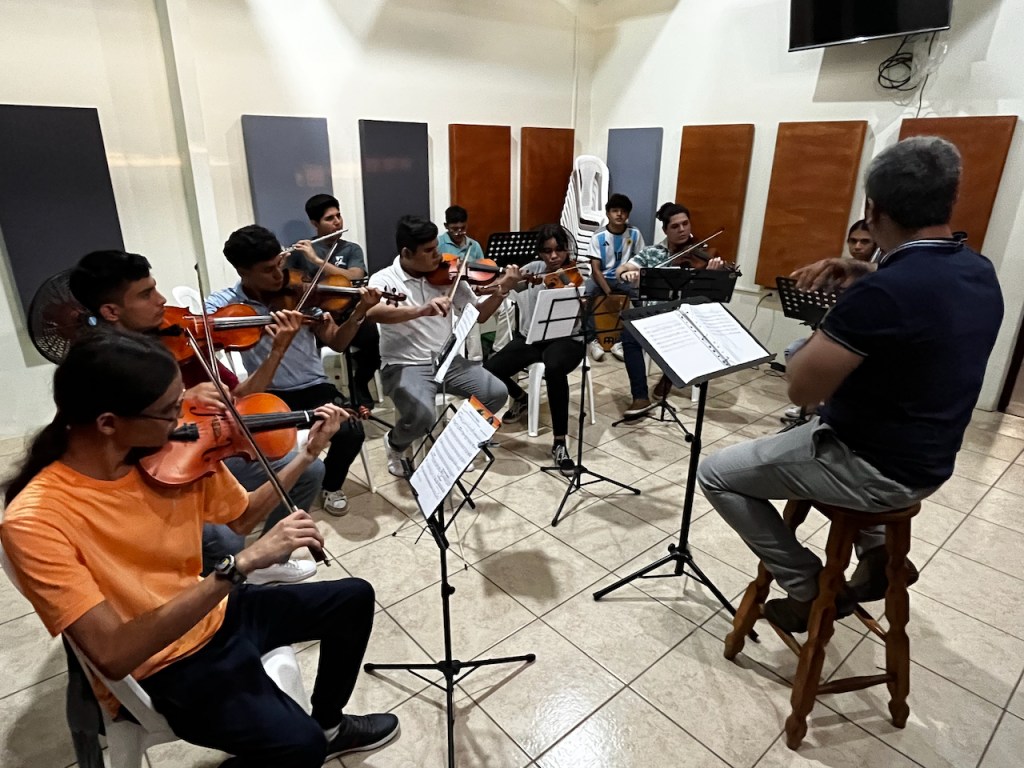
This week, in Central America, I met a musician who has worked unpaid for years, teaching classical music to young people. Now, after 12 years, the group have won some support and have a base where 30 young people come for classes five times a week. It was moving to watch his gentle, demanding way with a group of adolescents, and their return of focus on what they were playing. For a while, nothing mattered except the sound of co-creation, and the feelings it can bring.
There is, in one sense, nothing special about this. The same week, I also met artists doing good work with communities in theatre, visual art, and circus. And yet that it happens everywhere, all the time, is also what makes it special.
Over the years, and against my expectation, I’ve become persuaded that there is a universal language, ethos and practice of community art. No one has written it down, but when professional and non-professional artists create together, they seem to discover the same things. Observing community music workshops in Central Asia I saw the same processes, interactions, feelings and learning as in Central America, though the music, culture and social context were so different. The artists I spoke to this week would understand without difficulty those I’ve met previously in Burkina Faso, Kyrgyzstan, Poland, Japan or Colombia. They would take pleasure in working together and learning from each other. For all the differences of culture, these artists have much in common that comes from their practice and their marginal situation.
They invest their artistic energies with others to make their communities, perhaps even their societies, a bit better. Most have little money and do other work to subsidise their creative time. They work hard, often without reward except the joy of art making with others. They take risks, often by the nature of their work, sometimes merely by doing it independently, beyond the boundaries set by an indifferent or authoritarian state. (Some told me that they would be questioned by the security services after meeting me, so I’m keeping these words general, without names.) They’re generous with their time and ideas, and hungry to learn. They’re skilled and clever, creative and brave, making few resources go far and turning obstacles into opportunities. They love what they’re doing and that love spreads to everyone they work with, directly and indirectly. Despite the conditions, there’s happiness in workshops and performances I’ve seen. And they’re clear-sighted about what they do, its importance and its limits. It is always a joy to spend time with them and I go away humbled and hopeful. This is what community art has always meant to me.
So why do I see it more often in the world’s poorest places than in my own comfortable European society? Why does the work of community artists in the Global South seem so much more energised and meaningful than in the rich North?
The reasons are complex and I don’t understand them all. Some are entangled with questions of politics, economics and justice, so that the differences I see are really symptoms of much larger inequalities. Others are to do with the evident need and the effectiveness of the responses made to it. Still others with my own blinkers and prejudices.
But one thing stands out. None of this work has been captured by power. It happens on the margins, largely unseen and ignored by state actors. Consequently, it can nourish a real alternative to the normative (and increasingly indistinguishable) ideologies of government and consumer capitalism. It enacts humanist values of connection, open-mindedness, tolerance and dialogue. It puts freedom before security. People before art.
Like everyone else in an interdependent world, artists make compromises to live. I don’t mean to idealise those who, with fewer choices in harder conditions, make braver choices than I have ever had to. But their example inspires and challenges me to be a bit more courageous than I want to be.
 François Matarasso
Response to “Some selfless artists”
Really inspiring!
LikeLiked by 1 person