The Museum of Unrest is the latest project of John Phillips who was one of the founders on Paddington Printshop, a pioneering community print facility set up in the 1970s as part of the first wave of the community arts movement. It’s a fascinating online and real-world project that continues the thinking of those early years in a contemporary context. Their latest project, curated by Belinda Kidd, is about the history of community arts: you can discover it online here. Belinda asked me to write a text for this, and that’s on the site. I’m including it here too because this site is the archive of my work.
Fearless Days
The accident of when and where we are born defines our life, although these are such fundamental facts of our being that they are easily taken for granted. I became a community arts worker because of an especially favourable alignment of my needs with the available opportunities when I was young and searching for a role. Many of the conditions that made this possible are now unthinkable so I doubt whether, if I was starting today, I would become a community artist. In 1981, there was a unique combination of support and freedom that both attracted me and made possible a way of working that suited me.
The support will seem extraordinary to young people trapped in unpaid internships and menial jobs. My entry into community art was by way of a full-time, year-long paid apprenticeship with Greenwich Mural Workshop, in South East London, where I was instructed in mural painting, screen-printing and the theories behind community art. I earned £60 a week when my rent for a room in a shared house was £15. It was enough to live on without money worries, while the apprenticeship model was a safe and supportive way to learn by doing.
The following year I got my first job as a community artist, setting up a new project on a council estate in Newark-on-Trent, a market town in the East Midlands. The County and District Councils and the Regional Arts Association (from the Arts Council) had provided an annual budget of £12,000, half for a salary and the rest for a project budget. Crucially, the funding was provided to give working people access to the arts. No other outcome was expected; my job was simply to involve people who did not go to theatres or galleries in creative activities. In the three years I was there, we did theatre, printmaking, photography, puppetry, fireshows, murals, video and creative writing. If I didn’t have the art skills, I had funds to bring in people who did.
This range of work was necessary because I soon learned that the artistic specialisation possible in a London borough was inappropriate to an estate of 10,000 people. Variety was essential to keep people’s interest and respond to their different needs. It was possible because community art was barely 15 years old and there was not yet an established way of working nor expectations about its forms or aesthetic. With few precedents I had the freedom to explore and I made the most of it. The funders seemed to have few expectations either, other than activities with good community participation and support. I’ve rarely had as much fun in my work as I did in Newark.
Each year, I wrote an annual report describing what we’d done but that was easy because we were proud to tell others about our projects. I did not hear the word evaluation in the first ten years of my working life: there was a general belief that bringing art to working class communities had value in itself.
That support and freedom was mirrored in other aspects of my working life. For instance, in 1982, there was neither a national curriculum nor an Ofsted inspectorate so it was easy to work with the local primary school on a fireshow. Supportive teachers were happy to give a class the chance to do art for a week, believing that such experience would do the children as much good as English and maths. Likewise, we were welcome in hospitals and day centres and especially in the youth clubs that were still organised by a County Youth Service. Our resources was limited but we made good use of scrap materials and developed a distinctive aesthetic that made community art visibly different and approachable to participants and audiences. We rejected art world values and aestehtics—the newsletter of the National Association for community art was called Another Standard—and made work whose form expressed its origins.
There’s a line in an Elvis Costello song called Dirty Rotten Shame that I have always liked:
‘It isn’t youth, it’s fearlessness
That has been wasted on the young.’
I was fearless then, at least where my community art practice was concerned, ready to try my hand at anything, always believing that things were possible, that people would want to be involved, that doors would open – and they did. I said yes to everything and if I didn’t know how to do it, I asked someone who did and learned alongside them. I had energy and enthusiasm; I trusted that I was doing something worthwhile. I discovered what a very long way that could take me.
I don’t mean to romanticise those fearless days. I’m glad that we now have better safeguarding and risk assessments in place and that we no longer rely on good intentions alone. Arts management is far more professional than it was but that has come at a high price: too often now, people tell me why something can’t be done rather than looking for ways to do it. It has become the norm to keep within the tramlines set by funding bodies and other authorities. But the essence of community art, at least for me, is to keep asking why things should be done in the established ways and to keep exploring alternatives in search of great artistic experiences and new places where people can find each other and themselves. A culture of trust is not only efficient, it is empowering too.
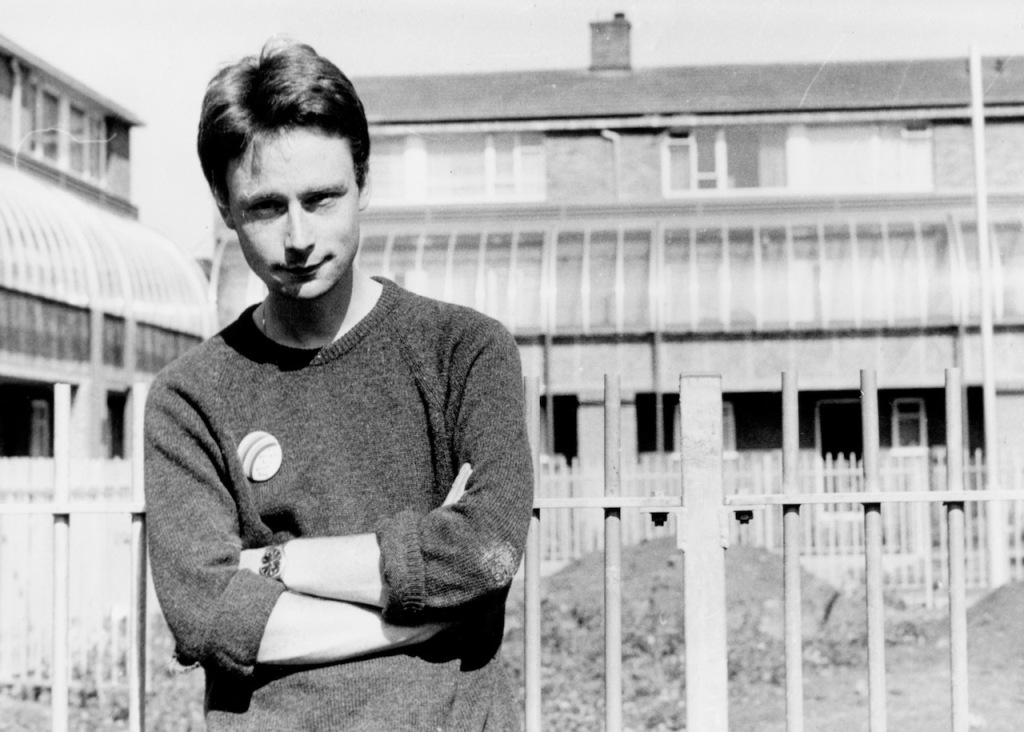
The photograph above was taken in 1984, at the time I have in mind in this text. I don’t remember who took it, but it will have been one of the young people on the estate I was working with. I have no idea why I’m not wearing my glasses.
 François Matarasso
Responses to “Remembering the 1980s”
Another corker – this all exactly: there was a general belief that bringing art to working class communities had value in itself.
Love the Elvis C line – brilliant.
But the essence of community art, at least for me, is to keep asking why things should be done in the established ways and to keep exploring alternatives in search of great artistic experiences and new places where people can find each other and themselves. Just brilliantly put, thank you.
‘beyond the sunset, and the baths Of all the western stars, until I die’
Love the photo too – pretty cool!
LikeLiked by 1 person
Thanks for the quote; I’ve never read Tennyson (I did 19th century French literature instead) so that’s something to explore.
LikeLike
Again, I can’t take credit for reading him, but I’m getting better, sometimes feels hard to access, but I was reading CCharge of the Light Brigade recently thinking wow! My brother William, has given me lots to think about with Tennyson. My brother, like you, is a great thinker, reader and writer, and yet for some time, in a letter I kept of his for years was the quote, “will my tiny spark of being vanish in your deeps and heights?’ which I thought he’d written! I thought it was pretty good until he said “that’s Tennyson!!”
LikeLike
You can download a free PDF of the fantastic book Bath Arts Workshop, Counter Culture in the 1970s on http://www.bathartsworkshop.org
Or you can buy a hard copy on the Tangent Books website. A must for all those interested in the development of community arts and are frustrated by those tramlines mentioned by Francois . Hugely impressive , beautifully illustrated and also very funny!
LikeLike
It is a very good book about the early days of community art. I wrote about it here: https://arestlessart.com/2021/10/02/other-peoples-books-some-recommendations/
LikeLike
[heart] Hugo Seabra reacted to your message:
LikeLike