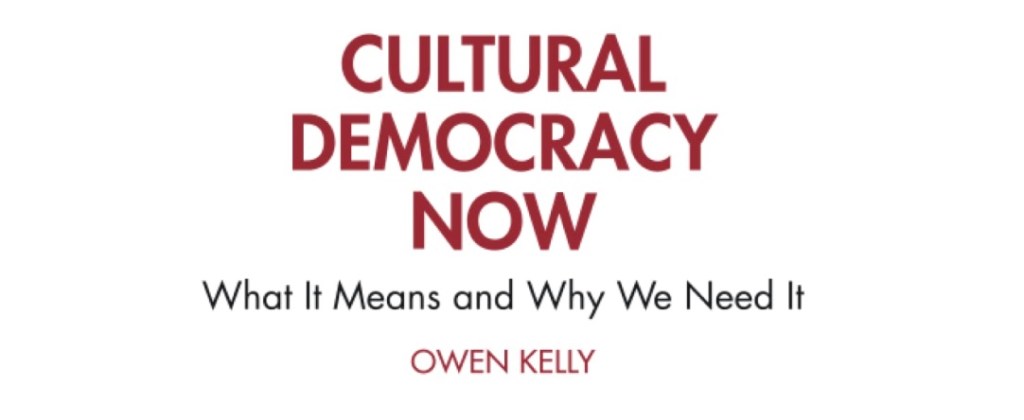
When I saw Owen Kelly in March, he generously gave me a copy of his new book, Cultural Democracy Now, and urged me to give him honest feedback. I started reading it on the journey from Helsinki, but hadn’t made much progress since, partly because of personal events, but also because it’s a challenging read. It is beautifully written, in Owen’s clear and sympathetic voice, but his analysis of cultural democracy draws on a huge range of complex philosophical, psychological, economic, political and ideas. René Descartes, Susan Blackmore, Desmond Tutu, Alan Watts and Edgar Rice Burroughs appear alongside many other names.
In Part One, Owen writes about selfhood and identity, arguing that we become human beings through cultural processes of socialisation, and that culture is much less about individuals than communities. I think he’s broadly right, though there are aspects I see differently and my path to that place has different way markers (less science and more practice). The focus on ‘we’ is one reason why I still use the term ‘community art’.
In Part Two he looks at various ‘cultural landscapes’, and particularly at how capitalist economics has not just commodified culture, but sought to shape our imaginations and desires in the pursuit of profit. There are some fascinating examples here, ranging from the reinvention of shopping as an entertainment to the manipulation and exploitation of social media. Again, it takes in areas of which I know little or nothing.
It’s not until Part Three that Owen turns to definitions of cultural democracy, because, as he explains to Sophie Hope in the latest episode of the MIAAW podcast, he felt it was important to consider the context in which cultural democracy might happen and be necessary. He considers several English-language definitions, of which the most important might be that of Rachel David DuBois, and American educationalist who founded the Workshop for Cultural Democracy in 1946 and makes a connection between political, economic and cultural democracy that Owen takes forward in his book.
This intellectual mapping informs how Owen sees cultural democracy in relation to community—the ‘we’ implicit in the idea of culture—and the political and economic structures that shape it. I particularly like his idea that one way of subverting some of today’s exploitative forces is to forget them, or perhaps to unlearn them. I feel much the same: in an attention economy, refusing to pay attention can be a form of resistance. The book is a rich source of ideas that that resonate with my evolving thinking about ‘a selfless art’, though my concerns still focus on the everyday practice and experience of co-creation.
One reason I continue to make podcasts with Arlene Goldbard, Sophie Hope and Owen Kelly (despite my limited craft) is that we think and work very differently. We have a common vision of cultural democracy—it’s the cornerstone of the whole project—but each of us looks at that mountain from a different political, theoretical, aesthetic, practical, philosophical and spiritual angle. I listen to the episodes Sophie and Owen produce, together or individually, with pleasure, even if I don’t always understand or agree with what’s being said. As a whole, the MIAAW podcasts benefit from our diversity of perspectives, and of the many guests who join us in talking about what cultural democracy is and why we need it.
Cultural democracy can never be one thing since its starting point is mutual respect for the diverse cultural values of the communities that make up our interdependent humanity. In my last post I was critical of the current debate about arts policy because there is so little acceptance that these questions are as complex as they are important to our lives and societies. I don’t know the answers, but we won’t find them unless we think creatively, imaginatively and generously. Owen Kelly’s book does just that and so makes a valuable contribution to an ancient but vital debate
You can buy Owen’s book from Routledge or listen to him and Sophie talk about it free in Episode 62 of Meanwhile In An Abandoned Warehouse.
 François Matarasso