
25 April 2013
Four weeks ago, the Louvre Museum presented the largest overview of German painting ever seen in France. De l’Allemagne, 1800-1939 De Friedrich à Beckmann brings together 200 works, most of them not seen in France before. The exhibition was conceived to celebrate the 50th anniversary of the Traité de L’Elysée, which is a key symbol of reconciliation and friendship between France and Germany.
It is distressing to many people, therefore, that the exhibition has become a source of anger and controversy, described in Le Monde as ‘Le grand malentendu’ (The great misunderstanding). Several German critics have seen the curatorial narrative as seeking to demonstrate a continuity in German culture of which Nazism is the inevitable, even natural, outcome. They question the concept of nationalism in understanding the art of a people who were not part of the same nation before 1870. Others see too little representation of radical modernists such as Blaue Reiter, Dada and Bauhaus.
The exhibition’s defenders, who include German critics and the German Ambassador in Paris, have tried to show how such essentialism was the very opposite of the curators’ intentions. On the contrary, they argue, its purpose is to open the eyes of the French public to the richness and diversity of an art they barely know. The exhibition’s focus on German culture’s relationship with the past, with nature and with the human was specifically chosen to avoid any risk of interpretation worked backwards from the shadow of the Second World War.
The argument has grown and involved politicians as well as the media: German MPs are planning to visit the show before it closes on 24 June. Existing tensions about the continuing crisis in the Euro and Germany’s role in the EU have crept into the discourse.
This is hardly surprising. An art exhibition is not neutral: if it were, it could be programmed by computer. It is an interpretation, an organising vision of the messy complexity of the actual world. As such, it is always likely to be contested, particularly when it represents one country’s vision of its neighbour, and describes a period in which they were engaged in four terrible wars.
It is not surprising and in many ways, it’s very healthy. Art is one of the ways we talk to one another. It can be how we learn about others and see ourselves in the other’s mirror. It is part of what I mean by The Parliament of Dreams.
At the same time, this row underlines the naivety—or bad faith—of discourse that claims to be concerned only for art’s intrinsic value. De L’Allemagne was curated by world experts in European painting with the stated intention of focusing on artistic and aesthetic history. How could they forget that it also, always, means something?
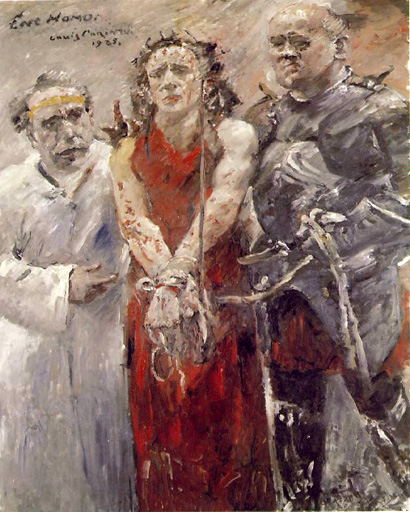
The paintings on this page are Der Watzmann (1825) by Caspar David Friedrich and Ecce Homo (1925) by Lovis Corinth, both of which were included in the Louvre exhibition. This was originally posted on the old Parliament of Dreams website on 25 April 2013. It is republished here without changes or updates
 François Matarasso
