Here is the latest post from my new project, A Selfless Art, which I’m publishing here because it has a bearing also on A Restless Art. I mostly post on the new website now, so please go there to read about my current ideas.
In 1997, I published a study of the social impact of participation in the arts that I called Use or Ornament? It was written for my peers working in community and participatory art, and came as much from my own experience in the field as from the research I undertook. I was happy and relieved that other community artists were enthusiastic about the work, telling me that it was both an accurate description of their work and a useful source of ideas about its outcomes and value. But, a couple of years later, the work was dismissed in an academic journal on a misreading of its methodology. Being who I am, I took the criticism to heart and for I took pains to make my subsequent work methodologically irreproachable.
It took me some years to see that I’d made taken a wrong turn. I had accepted academics’ assessments of their own theories and practice at face value. I came to see academic ideas as subjective and flawed as any others, and producing work I had little interest in reading.
So I changed my approach again, working on a series of books under the common title, Regular Marvels. They followed two principles.
- First, that art is itself way of knowing and so using the methods of literature, visual art, video and photography is as valid as academic research methods. More than that, it is coherent with my underlying belief that art is inherently valuable in giving human beings unique capabilities.
- Secondly, I wanted the books to be accessible to those about whose work and experiences I was writing. They were designed to be attractive and well-written. They can be read in a couple of hours by anyone with an interest and basic language skills.
Since then, I’ve continued to balance rigour and accessibility, writing always for people active in community art, whether professionally or in other ways, hoping to give them ideas, information and evidence that could be useful in their work. And that is the point. The harshest critique of Use or Ornament? was useless. It dismissed its ideas on methodological grounds so that it needn’t consider what truth or value they might have. It was itself ornamental, written to be admired within its narrow world, and to defend equally narrow artistic practices. It had nothing for the people involved in participatory art, whether as artists, funders or managers, or to the millions who create art non-professionally in a myriad ways and for as many reasons.
Thirty years ago, I was inexperienced or naïve about many things, including politics and academia. Less so today, especially in recognising better some of the gaps in my knowledge and understanding—my known unknowns. There are always, of course, the unknown unknowns, but at least I am aware that they exist. Among other changes, my idea of truth has become much more complex. I still believe that there is a difference between truth and falsehood, though it may be more contextual than I once thought, and I still believe that difference is fundamental to everything we think and true.
But I understand better than when we write about social life, as I did in Use or Ornament?, we are constructing an explanatory narrative that is incomplete, partial and distorting. We are map-making, and only a fool mistakes a map for the territory. Actually, I used exactly that metaphor in the opening words of the book:
Evaluating the social impact of participating in the arts has long been a sort of terra incognita, a continent whose existence is known, but which remains unexplored. Travellers’ tales, where they existed, were full of mystery and menace, implying a land filled with dangers for the unwary. The sketchiness of the information encouraged some to argue that El Dorado lay there, while others asserted it was a desert, a wasteland best avoided. Our research has sought to throw some light on this shadowy region by establishing a base for further exploration. We have cleared some ground and begun to open up routes to the interior, some of which may prove to be dead ends. If the flora and fauna are unfamiliar, we have at least encountered no monsters.
François Matarasso, Use or Ornament?, 1997, p. IV
Use or Ornament? mapped a territory and offered new ways of thinking that remain current today. And that is what matters. When we set out to understand a practice as diverse, subtle and complex as co-creation we are interpreting reality not reflecting it.
The tools and methods of scientific research are necessary but insufficient. We also need experience, knowledge, empathy, creativity and imagination.
We need to understand that we are drawing maps and the test of their value is whether they are useful in helping us get to our destinations.
•
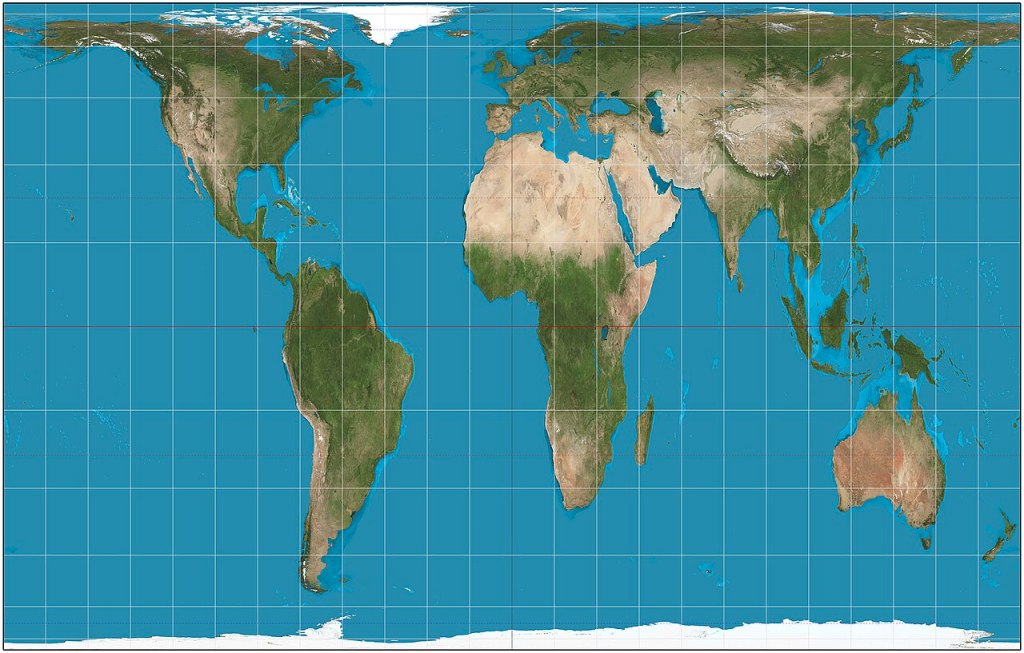
The illustration is the Gall-Peters projection of the world, which gives equal areas of the world’s land masses at the cost of distorting their shapes. The image is licenced under the Creative Commons Attribution-Share Alike 3.0 Unported license.
 François Matarasso